Practical advice for towing a touring caravan to Cornwall, from route planning to pitching on grass.
Cornwall is one of the most popular touring caravan destinations in the UK, and for good reason. The coast is spectacular, the beaches are beautiful and there are campsites to suit every taste. But towing to Cornwall, especially to the quieter north coast, takes a little planning. This guide shares our tips, based on welcoming touring caravans to our farm campsite near Boscastle.
Planning your route
Most caravanners reach Cornwall via the M5 and then the A30 or the A39. The A30 is the main dual carriageway into Cornwall, while the A39 Atlantic Highway runs along the north coast through Bude, Camelford and Wadebridge.
Avoid peak changeover times
Saturdays in the school summer holidays are the busiest days on Cornwall's main roads, as many holiday lets and caravan parks change over. If you can travel midweek, or set off very early, your journey will be much more relaxed.
The last few miles
The biggest challenge is often the last few miles. Many campsites in north Cornwall are reached by narrow lanes with high hedges and few passing places. Follow the campsite's directions rather than a sat nav, which can send you down unsuitable roads. Read our guide to driving narrow Cornish lanes and our directions to the campsite.
Before you set off
- Check your outfit's weights, including the noseweight and the payload in your caravan.
- Check tyres on the car and the caravan, including the age of the caravan tyres.
- Make sure the breakaway cable and lights are working.
- Check towing mirrors are fitted and adjusted.
- Make sure your insurance and breakdown cover include the caravan.
Driving tips
- Allow extra time. Hills are steep in places, and lanes are slow.
- Use lower gears on descents. Some Cornish hills are long and steep.
- Know your width. On narrow lanes, knowing how wide your outfit is helps when meeting oncoming traffic.
- Be ready to reverse. On single-track lanes, someone may need to reverse to a passing place.
- Pull over to let queues pass. It keeps everyone calmer on long, slow stretches.
Arriving and pitching
Grass pitches
Many Cornish farm sites, including ours, have grass pitches. These are lovely to camp on, but you need the right kit and a little care.
- Bring levelling ramps or blocks.
- Use corner steady pads on soft ground.
- After heavy rain, ask the site for the best pitch and avoid spinning wheels on wet grass.
- A motor mover is very helpful on grass and in tight spaces.
See our guide to levelling a caravan on grass.
Hook-up
Bring a long hook-up cable. On grass sites the hook-up point may be some distance away. Our electric hook-up explained guide covers the basics.
Awnings
Awnings are free at Lower Pennycrocker Farm. On the north Cornish coast, wind can pick up quickly, so use storm straps and good pegs, and consider a porch awning rather than a full awning if you are only staying a few nights.
Days out without the caravan
Once you are pitched, leave the caravan on site and explore by car. From Lower Pennycrocker Farm:
- Boscastle is about two miles away, with its harbour, cafés and walks. See our Boscastle harbour guide.
- Tintagel is about seven miles away.
- Bude is about 15 miles away.
- Bodmin Moor, including Rough Tor, is about six miles away.
Parking in Boscastle and Tintagel can be busy in high summer, so go early. Our Boscastle parking guide has more detail.
What to pack
As well as the usual caravan kit, we recommend:
- Levelling ramps and chocks.
- 25m hook-up cable.
- Waterproofs, even in summer.
- Windbreak.
- Walking boots for the coast path.
Our motorhome and campervan packing checklist also works well for caravans.
Touring at Lower Pennycrocker Farm
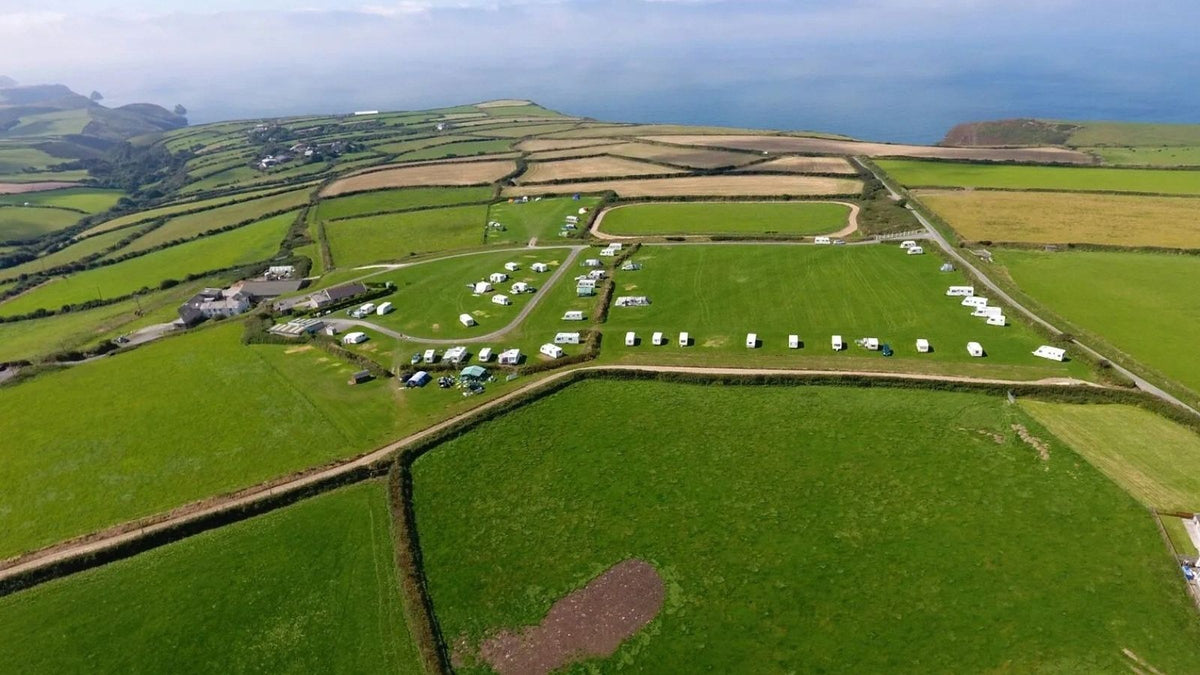
We are a working farm with open grass fields and sea views, about two miles from Boscastle and half a mile from the coast path. We welcome touring caravans, motorhomes, campervans and tents.
- Adults £10 per night; children 5 and over £5.
- Electric hook-up £7 per night.
- Awnings free.
- Up to two dogs per pitch, £2 each per night.
- Free showers, toilets and a washing-up room.
There's no shop, bar or entertainment, which our guests tell us is part of the appeal. Read more on our touring caravans and motorhomes page.
Waste and water
Ask the campsite about fresh water and waste disposal points when you book, so you can plan. Bring a water carrier and a waste container, and empty them regularly. At Lower Pennycrocker Farm, please ask us about the arrangements when you book.
Leaving
On your last morning, allow time to pack up, especially if the awning is wet. Pack the awning loosely and dry it fully at home to avoid mildew. Leave the pitch tidy, check the hook-up post, and take your time on the lanes back to the main road.
Frequently asked questions
Is Cornwall suitable for towing a caravan?
Yes. The main roads are fine, but some lanes near campsites are narrow. Follow the campsite's directions and allow extra time.
Do I need levelling blocks?
On grass pitches, yes. Our pitches are grass, so bring ramps or blocks.
When is the best time to tow to Cornwall?
Midweek, outside the school summer holidays, is the quietest. Avoid peak Saturdays if you can.
Are awnings allowed at Lower Pennycrocker Farm?
Yes, and awnings are free.
Before you travel, read arriving at Lower Pennycrocker Farm for check-in times and the last few miles of lane. Still deciding how to travel? Compare the options in tent, caravan or motorhome?.
Stay near Boscastle
Lower Pennycrocker Farm is a quiet, family-run campsite at St Juliot, about two miles from Boscastle (PL35 0BY). We welcome tents, touring caravans, motorhomes and campervans from 1 April to 31 October. Adults are £10 a night, children aged 5 and over £5, electric hook-up £7 and dogs £2 each (maximum two). Showers are free and you park beside your pitch. Check availability and book direct, or see pitches and prices.
Thinking about a longer stay? See seasonal pitches and longer stays in Cornwall and ask us what is available.
Touring by motorhome? Follow our north Cornwall motorhome route along the Atlantic Highway.